
Benefits Are the Currency of Strategy
Improving the practice of a benefits realisation-led approach in P3M: shifting from output delivery to strategic value creation
By Oladapo Famuyiwa, Senior P3M Consultant, BOF Consults · October 2026
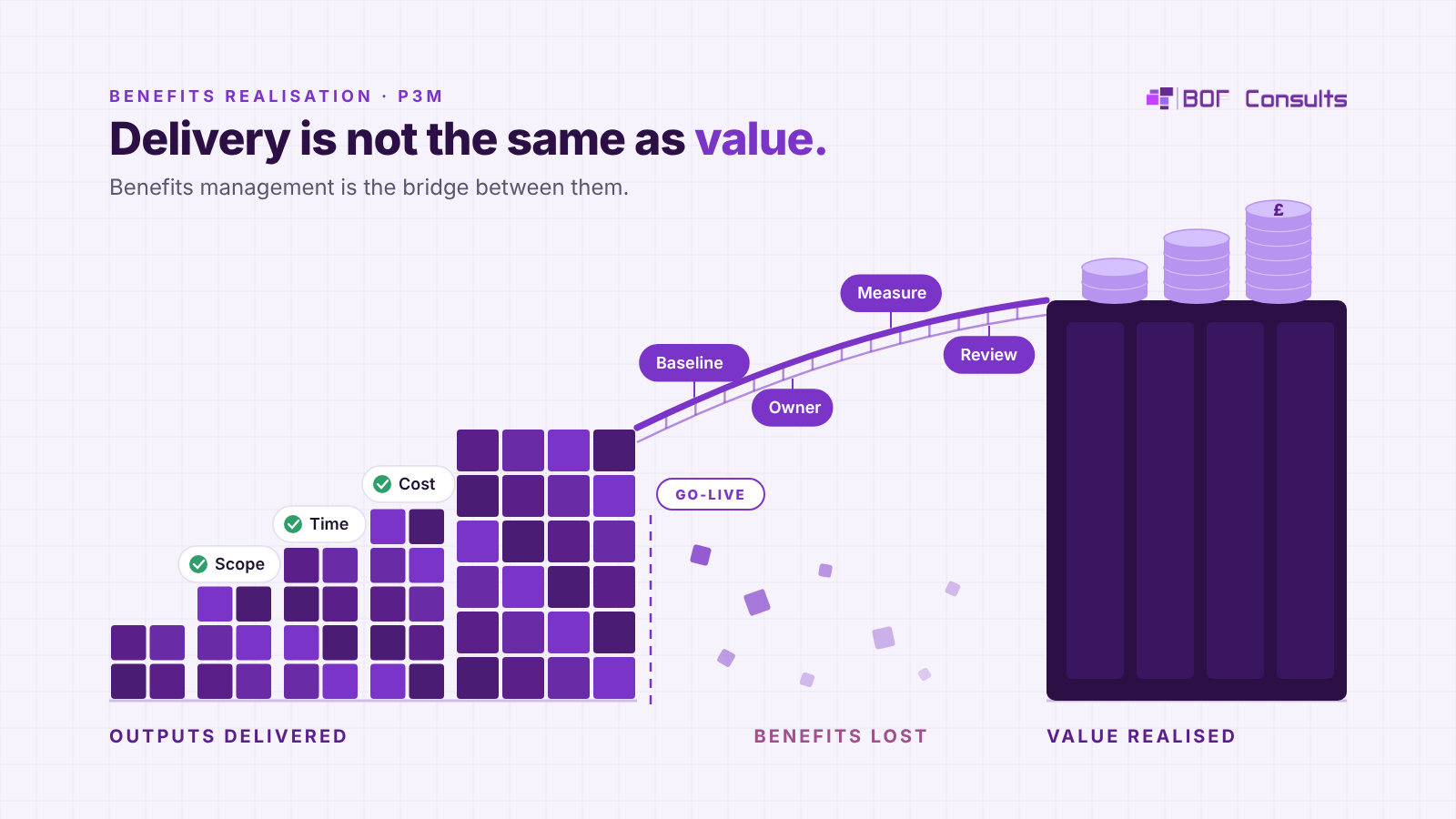
Most projects do not fail in execution. They fail in value.
This is my first article, and I wanted to start with the question that has followed me through more than 22 years of portfolio, programme and project management (P3M) in Defence, Aerospace, Nuclear, Infrastructure and Government: we invested in this, so what did we actually get back? Too often, nobody can answer it with confidence.
The numbers show why. The UK Government Major Projects Portfolio now holds 189 projects with a whole-life cost of £924.2bn and £603.6bn of monetised benefits (NISTA, July 2026). Only 15% are rated Green for delivery confidence. Globally, Bent Flyvbjerg and Dan Gardner’s database of 16,000 projects shows only 8.5% hit their time and cost estimates, and just 0.5% deliver on time, on budget and the benefits they promised (How Big Things Get Done, 2023).
In my experience, the pattern is the same almost everywhere: we manage delivery rigorously and value casually. This article sets out why that has to change, what a benefits realisation-led approach looks like, and how to build one.
1. Success through a different lens
Finishing on time is delivery success. Delivering value is business success.
The iron triangle of scope, time and cost remains necessary, but it is not sufficient. A project can land every milestone and still leave the organisation no better off. The evidence is consistent:
- 31% of complex projects fail to achieve the full scope of their intended benefits, and 61% of project professionals report value loss as a result of complexity (PMI Pulse of the Profession 2026).
- Professionals with high business acumen judge success on 9.1 factors on average, against 6.3 for everyone else, and more of their projects meet business goals (PMI Pulse of the Profession 2025).
- When benefits are identified before a project starts, 74% of projects meet their goals and business intent (PMI, 2016).
If you can’t measure benefits, you can’t manage value.
2. From output to value
We no longer manage projects. We manage outcomes and impact.
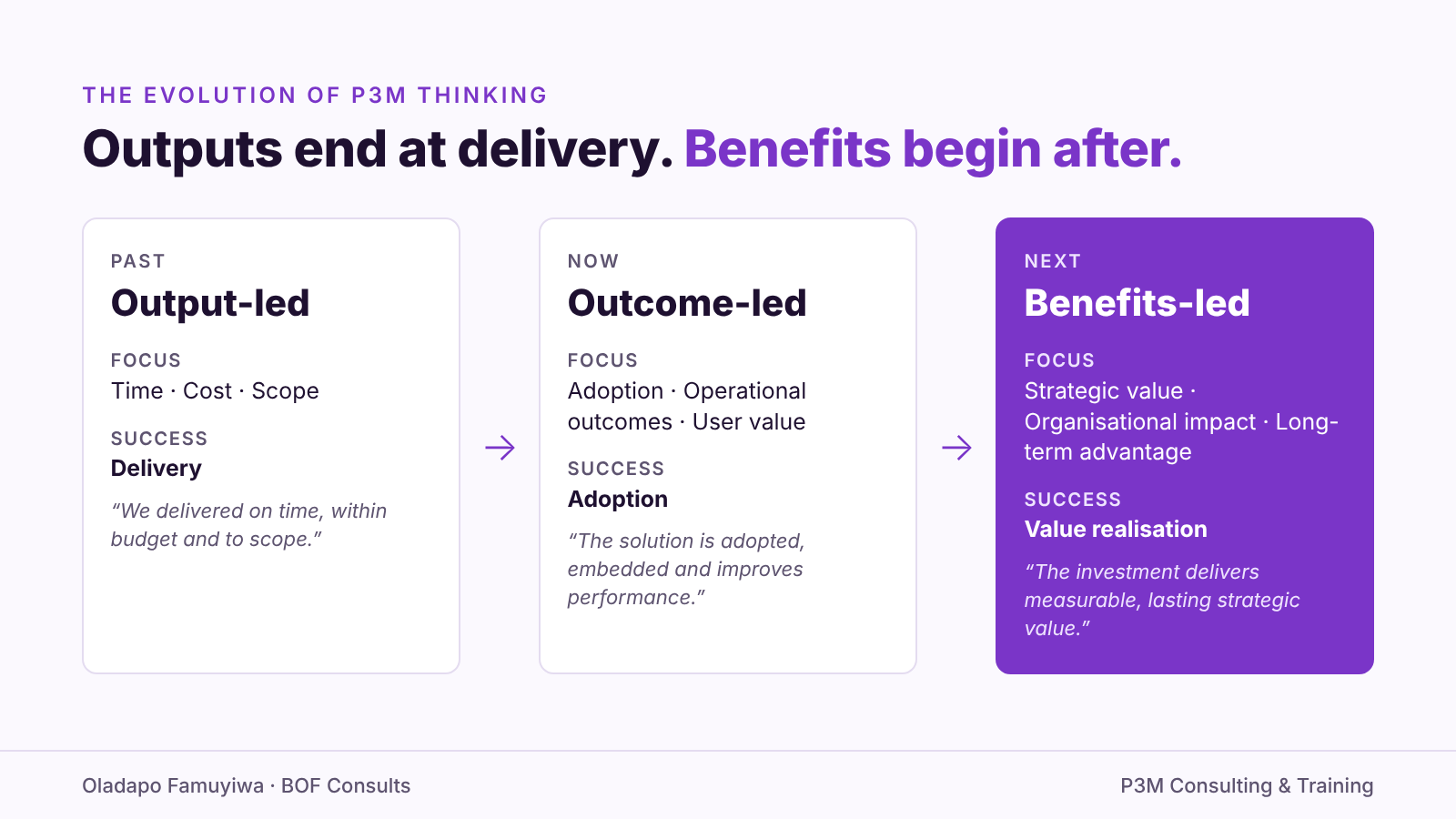
P3M thinking has moved from output-led (time, cost and scope), to outcome-led (adoption and operational improvement), and is now moving to benefits-led: measurable strategic value and lasting organisational impact. The traditional view stops at implementation. A benefits-led view carries on into post-implementation, where value is actually created. Outputs end at delivery; benefits begin after.
3. What “benefits-led” really means
Every benefit begins with a performance gap.
Performance gap = desired performance − current performance
The gap may relate to cost, capability, service quality, time, risk, compliance or capacity. It can come top-down, as a strategic mandate, or bottom-up, from the people closest to the work. Either way, it must be measurable, because that is what allows objective prioritisation, fair option evaluation and, later, proof that the gap has closed. What gets defined gets delivered.
Whoever spots the gap, whether in strategy, finance, the PMO, a project team or operations, acts as the Benefit Initiator: they establish the baseline, shape the first solution concept and hand the benefit to a named owner. Many of the benefit problems I see go back to that hand-over never happening.
A benefit is a measurable improvement that is valuable to one or more stakeholders. A benefits-led approach starts with why, not what, and plans backwards:
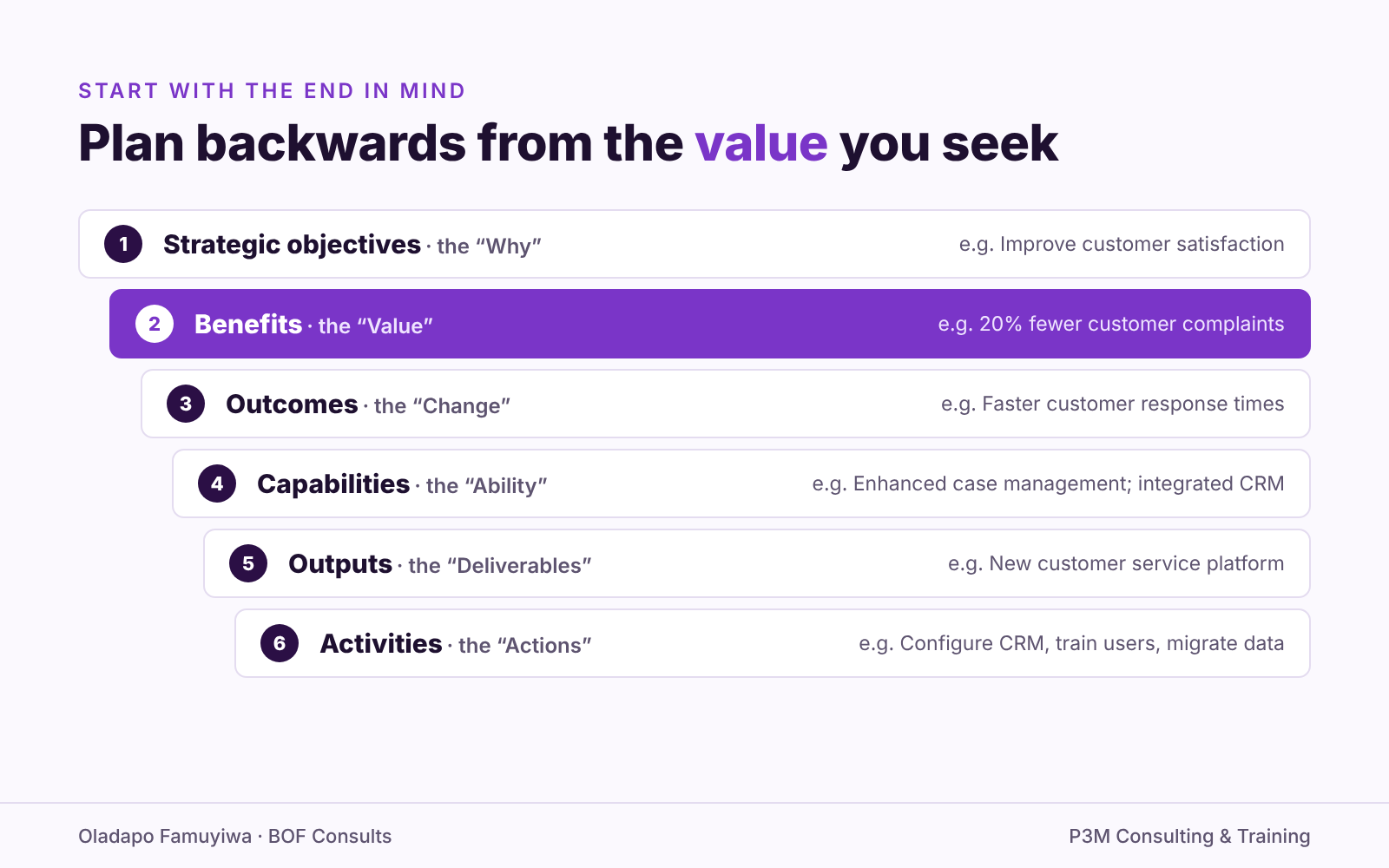
- Strategic objective (the “why”): improve customer satisfaction.
- Benefit (the “value”): a 20% reduction in customer complaints.
- Outcome (the “change”): faster customer response times.
- Capability (the “ability”): enhanced case management and an integrated CRM.
- Output (the “deliverables”): a new customer service platform.
- Activity (the “actions”): configure the CRM, train users, migrate data.
When planning runs backwards like this, every activity can be traced to the value it creates, and anything that cannot be traced deserves a hard question.
4. Traditional vs benefits-led P3M
The difference is between delivering outputs and realising value.
| Aspect | Traditional P3M (activity-centred) | Benefits-led P3M |
|---|---|---|
| Focus | Delivering outputs and deliverables | Delivering measurable outcomes and sustained value |
| Timing | Benefits identified late or after delivery | Benefits defined upfront and tracked throughout |
| Decision basis | Cost, schedule and scope compliance | Strategic value and alignment to intended benefits |
| Accountability | Project manager responsible for delivery | Benefit owner or SRO accountable for realising value |
| Measurement | Milestone completion | Benefit realisation, adoption and impact |
| Governance | Stage gates focus on delivery progress | Stage gates assess delivery progress and benefits readiness |
5. Reality check: why organisations struggle
The gaps show up at every stage:
- At the front end, benefits are written to justify the business case rather than to manage it: vague, unbaselined and owned by nobody.
- During implementation, governance tracks milestones, cost and RAG status, while benefits sit untouched in an appendix.
- At the back end, the project closes, the team disbands and nobody is left to measure whether anything changed.
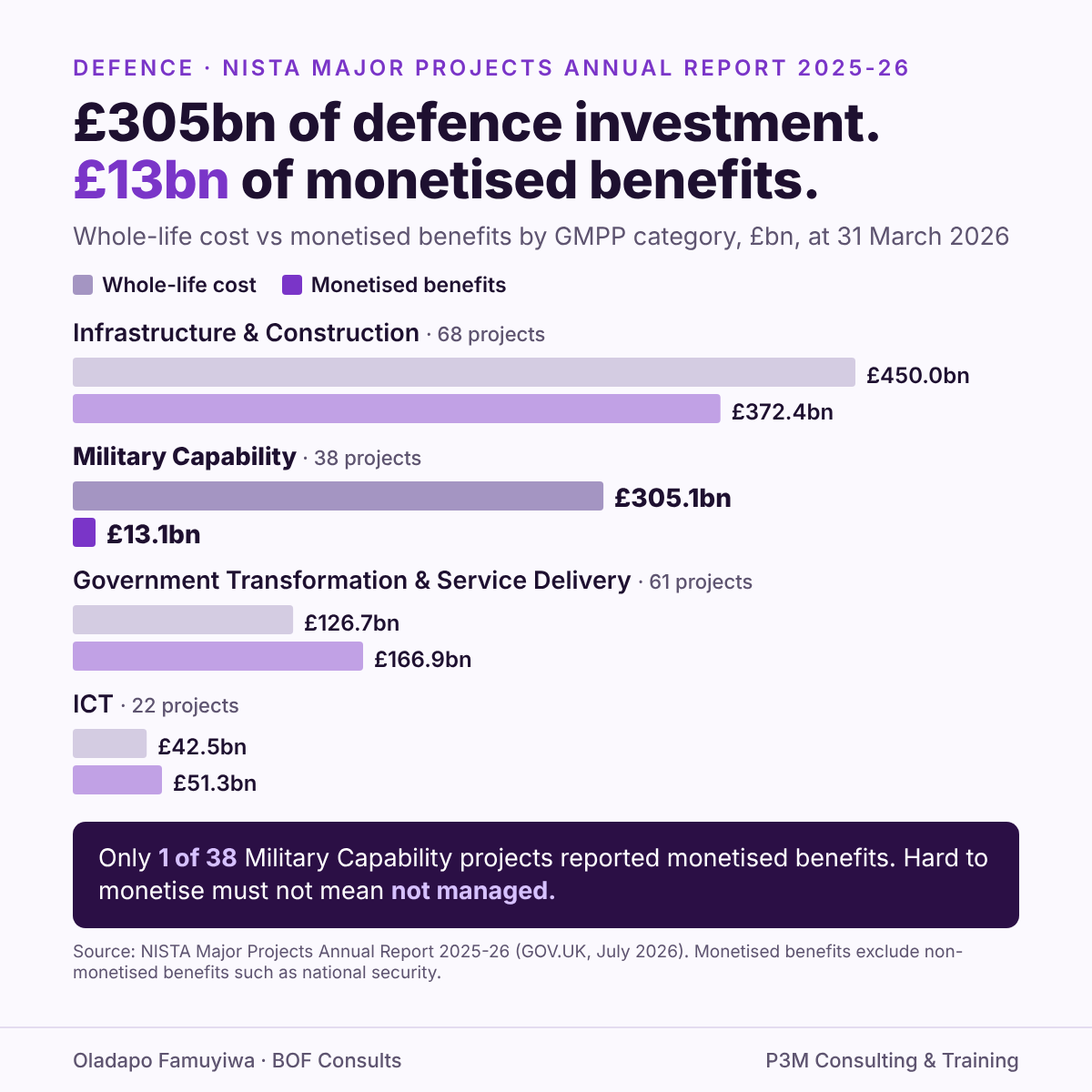
A defence example. In the NISTA 2025-26 report, the 38 Military Capability projects carry a whole-life cost of £305.1bn, yet report just £13.1bn of monetised benefits; only one of the 38 reported monetised benefits at all. NISTA’s explanation is fair: national security benefits are hard to monetise. But “hard to monetise” must not become “not managed”. Readiness, availability, operational effectiveness, interoperability and cost of ownership can all be baselined, owned and reviewed, and with programmes averaging a forecast duration of 20.3 years, that discipline matters more, not less.
A lesson from my own work: benefits must be evidenced, not assumed
On a major transformation programme within the Government Major Projects Portfolio, I joined as one of its projects was nearing completion. The savings being reported for it ran to more than a billion pounds. When I examined the claim, the evidence to support it was not there.
I set up a retrospective benefits realisation review through a programme-level Benefits Review Committee. Working with the business teams and Finance, we traced each claimed saving back to its underlying assumptions and supporting evidence.
The result was striking: less than 0.1% of the claimed savings could be substantiated.
That does not mean the project created no value. It means the value had never been defined, baselined or measured in a way anyone could evidence. A retrospective review can establish what has been achieved, but it cannot replace benefits management that starts before delivery. With clear benefit profiles, agreed baselines, accountable benefit owners, defined measures and regular tracking, the programme could have challenged unsupported assumptions much earlier and made better-informed decisions throughout.
The lesson: reported savings are not realised benefits. A transformation should not be judged only by what it delivers, the milestones it meets or what it spends, but by the measurable, evidenced and sustainable value it creates.
6. Building a benefits-led framework
Benefits are the currency of strategy. Embedding them takes four enablers.
Align the lifecycles. Benefits are identified and quantified before the project (ex-ante), planned and monitored during delivery, and realised and sustained after it (ex-post). That last stage is where most organisations lose sight of them, so someone must own it.
Ask the right governance question at each level.
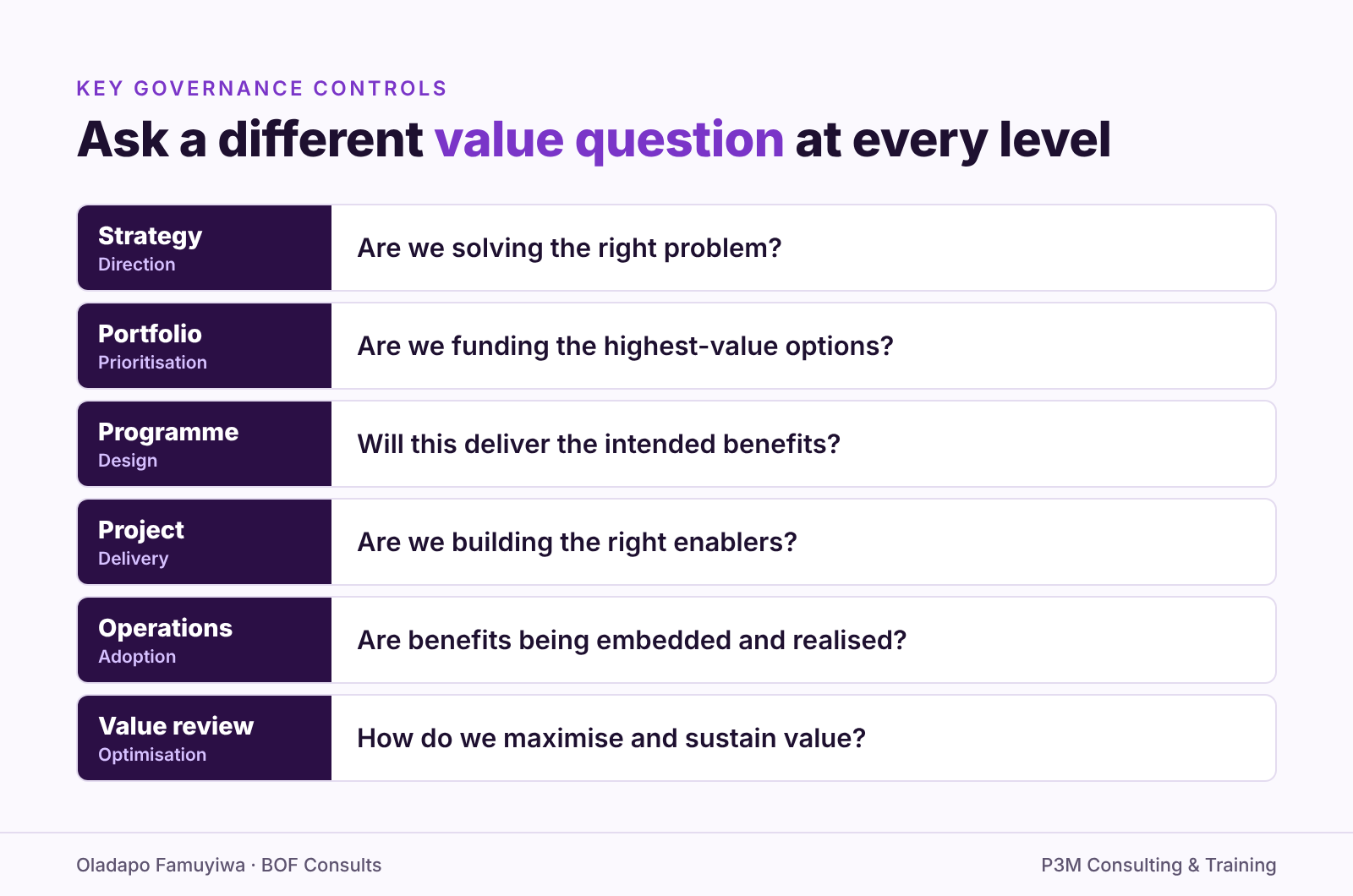
- Strategy: Are we solving the right problem?
- Portfolio: Are we funding the highest-value options?
- Programme: Will this deliver the intended benefits?
- Project: Are we building the right enablers?
- Operations: Are benefits being embedded and realised?
- Value review: How do we maximise and sustain value?
Map, measure and protect. Benefits maps link each output to the outcomes and benefits it supports, and dashboards track realised benefits against baselines, not tasks completed. Linking every risk, assumption, issue and dependency to the benefit it threatens turns risk management into value protection.
Drive cultural change. Frameworks fail without the right behaviours: leaders who champion value, named benefit owners with real accountability, recognition for realised benefits, and honest reviews of the benefits that were not realised.
7. From project success to strategic value
Five takeaways:
- Project success is evolving. “Delivery complete” is no longer enough.
- Benefits realisation changes the game. It puts measurable value at the heart of P3M.
- A structured process matters. Identify, track and report benefits consistently, linked to business cases, risks and performance measures.
- Alignment is critical. From strategy, to benefits, to outcomes, to outputs.
- Benefits realisation is strategic value management. It belongs in every business case, risk and performance conversation.
If you could change only one thing tomorrow to improve value delivery in your organisation, what would it be and why? I’d welcome your views: get in touch.
I’ll be expanding on these ideas in an upcoming webinar. Contact us to be told when it is released.
Oladapo Famuyiwa is a senior P3M consultant with BOF Consults, specialising in benefits realisation, integrated planning and PMO leadership across Defence, Nuclear, Aerospace, Infrastructure and Government. The views in this article are his own and do not represent any client or employer.
Sources
Work with a Partner Focused on Value, Not Just Delivery
If you are responsible for significant investment, complex change, or professional development, BOF Consults is ready to support you.