
The Hidden Danger of the “Lazy Risk”: Why Better Risk Language Matters
How risk metalanguage helps project teams distinguish causes, uncertain events and consequences — and develop more effective responses.
By Oladapo Famuyiwa, BOF Consults · October 2026
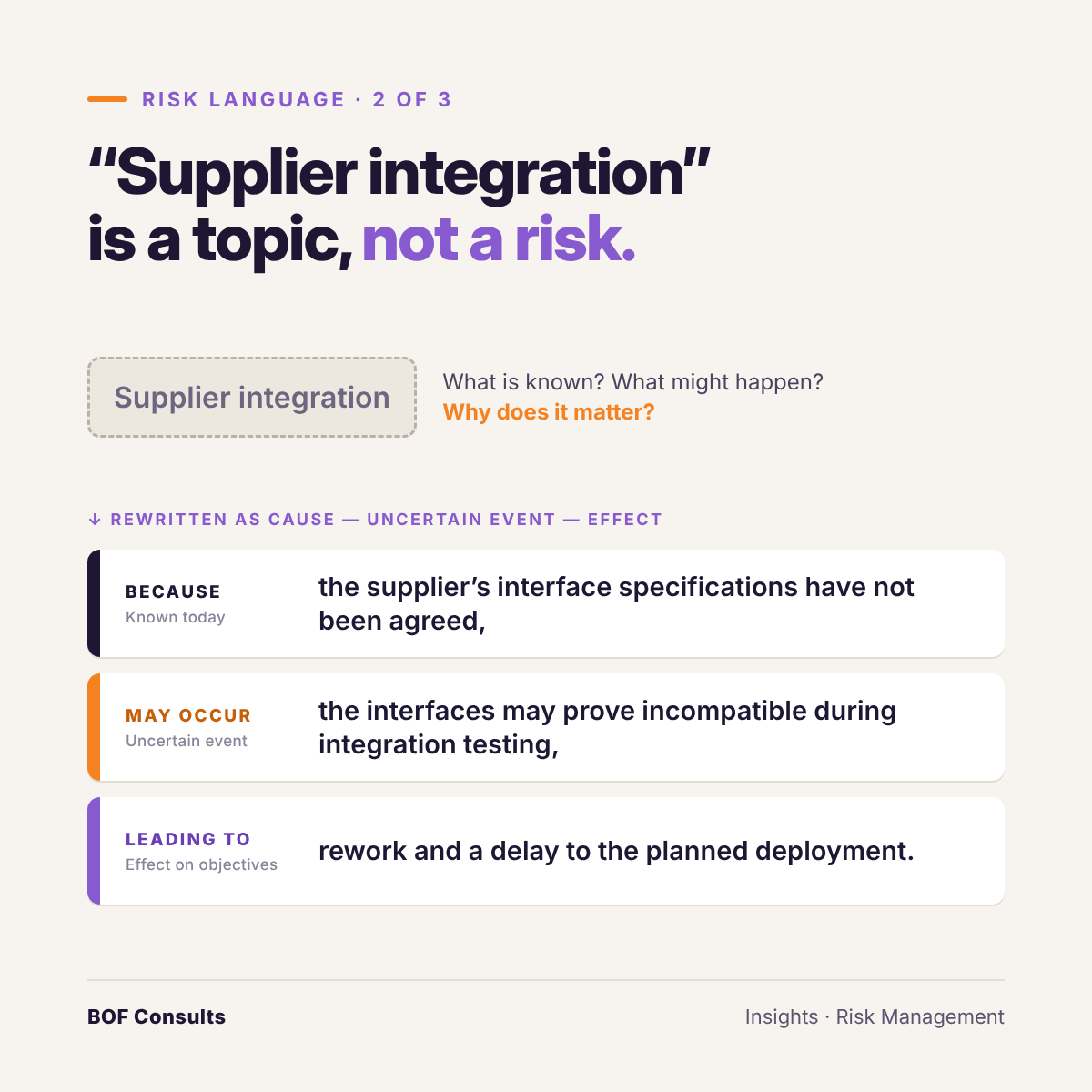
Look through almost any project risk register and you will find entries such as:
- “Third-party software integration.”
- “Lack of skilled resources.”
- “Project delay.”
Each one points to a genuine concern. But does it explain what might happen, why it might happen and how it would affect the project’s objectives?
Usually not.
“Third-party software integration” describes a dependency. “Lack of skilled resources” is either an existing constraint or a possible future shortage. “Project delay” is the consequence of an underlying risk — or an issue that has already materialised.
The distinction matters because each requires a different response.
When causes, uncertain events and consequences are blurred together, risk assessments become harder to interpret, mitigation actions can miss the source of exposure, and decision-makers struggle to see what intervention is actually required.
The answer is not simply to make risk registers longer. It is to make the information they contain more meaningful.
This is where risk metalanguage — a structured way of describing, classifying and connecting risks — can help.
What is risk metalanguage?
The cause–risk–effect approach to risk metalanguage was set out by Dr David Hillson in his 2000 article, Project Risks: Identifying Causes, Risks, and Effects, published in PMI’s PM Network. Hillson subsequently developed the approach in his Risk Doctor briefings on risk identification and risk responses.
Its central principle is straightforward: distinguish the cause, the uncertain event and the potential effect on objectives.
A useful structure is:
Because of [cause], [uncertain event] may occur, which could lead to [effect on objectives].
This formulation helps risk owners articulate what is known today, what might happen in the future and why it matters.
The same structure works for opportunities as well as threats. For example: because the team is recruiting recent graduates, they may introduce more efficient working techniques, which could shorten delivery time.
From a vague risk to a decision-ready statement
Consider this entry:
Risk: Vendor delay.
It is concise, but it leaves several important questions unanswered.
Why might the vendor be late? What delivery could be affected? What would happen if the delay occurred? Which objectives would be exposed?
A more useful statement would be:
Because the project depends on a single supplier for a critical component, an interruption to the supplier’s production may delay component delivery, potentially affecting system integration and the planned release date.
The statement separates the existing dependency from the uncertain interruption and its potential consequences.
The project team can now investigate supplier resilience, assess the delivery schedule and identify suitable treatment options.
For example, dual-sourcing or qualifying an alternative supplier reduces dependency on a single source. Re-sequencing work or preparing an alternative testing approach reduces the consequences if delivery is delayed.
The figures, dates and circumstances in such examples should be based on actual project evidence; they should not be invented to make a risk statement appear precise.
The opposite problem: the risk buried in a narrative
Vague entries are not the only way risk information fails. Sometimes the problem is too much text rather than too little.
On a large-scale data centre project/programme in Europe, I worked as a consultant alongside project and programme teams that used an early warning methodology to manage risks and changes. Some technically oriented contributors documented risks in lengthy narratives, sometimes running to one or two pages. Those narratives could contain useful technical detail. But the essential elements of the risk were often difficult to identify: what was creating the possibility of the risk, what uncertain event might occur, what the consequences could be, and what actions might reduce the likelihood or the impact.
I delivered training to help contributors formulate their risks more clearly. We separated the cause, the risk event and the consequence, and identified mitigation actions individually rather than leaving them embedded in the description.
The lesson applies well beyond data centres. A three-word title and a two-page narrative fail in the same way: neither tells a reviewer, quickly and reliably, what is uncertain and why it matters. Technically detailed risk information has value, but it must be structured so that it can be understood, assessed, communicated and acted upon.
A clear statement does not resolve the risk. It gives risk owners, reviewers and decision-makers a shared starting point, and makes it easier to see whether the proposed actions address the right part of the risk.
1. Distinguish risks from existing issues
A cause is a fact or condition that exists, or is expected to exist with sufficient certainty in the context being assessed. A risk concerns uncertainty about a future event or set of circumstances that could affect objectives. A consequence describes the potential effect if the risk occurs.
An issue, by contrast, is generally a problem or event that has already materialised and requires active management.
These distinctions are important, although real project situations can be more nuanced than a simple label suggests.
A confirmed shortage of specialist staff may require immediate action. The possibility that a future shortage will prevent a critical activity from starting is a risk. A missed milestone resulting from that shortage is a consequence that may already have occurred.
The team should not stop managing the issue merely because it originated as a risk. Nor should it continue treating a realised event solely as a future uncertainty.
Clear descriptions help establish the appropriate response.
2. Target the right part of the risk
A structured risk statement also improves the conversation about treatment.
For threats, some measures address the causes or conditions that make an event more likely. Others reduce the likelihood directly, limit the consequences or prepare the organisation to recover if the event occurs.
Using the supplier example:
- Address the source of exposure: reduce reliance on a single supplier or improve supplier assurance.
- Reduce the likelihood: strengthen monitoring, production visibility or early-warning arrangements.
- Reduce the consequences: resequence activities, qualify alternatives or develop an appropriate fallback plan.
- Prepare for recovery: define decision triggers, ownership and contingency arrangements.
These options are not interchangeable, and the right combination depends on the nature of the risk, its assessed significance, the available controls and the cost of treatment.
Record each action separately from the risk statement. The statement describes the uncertainty; the actions describe the response. Kept apart, each action can have its own owner and target date, and reviewers can see at a glance which part of the risk it is meant to influence.
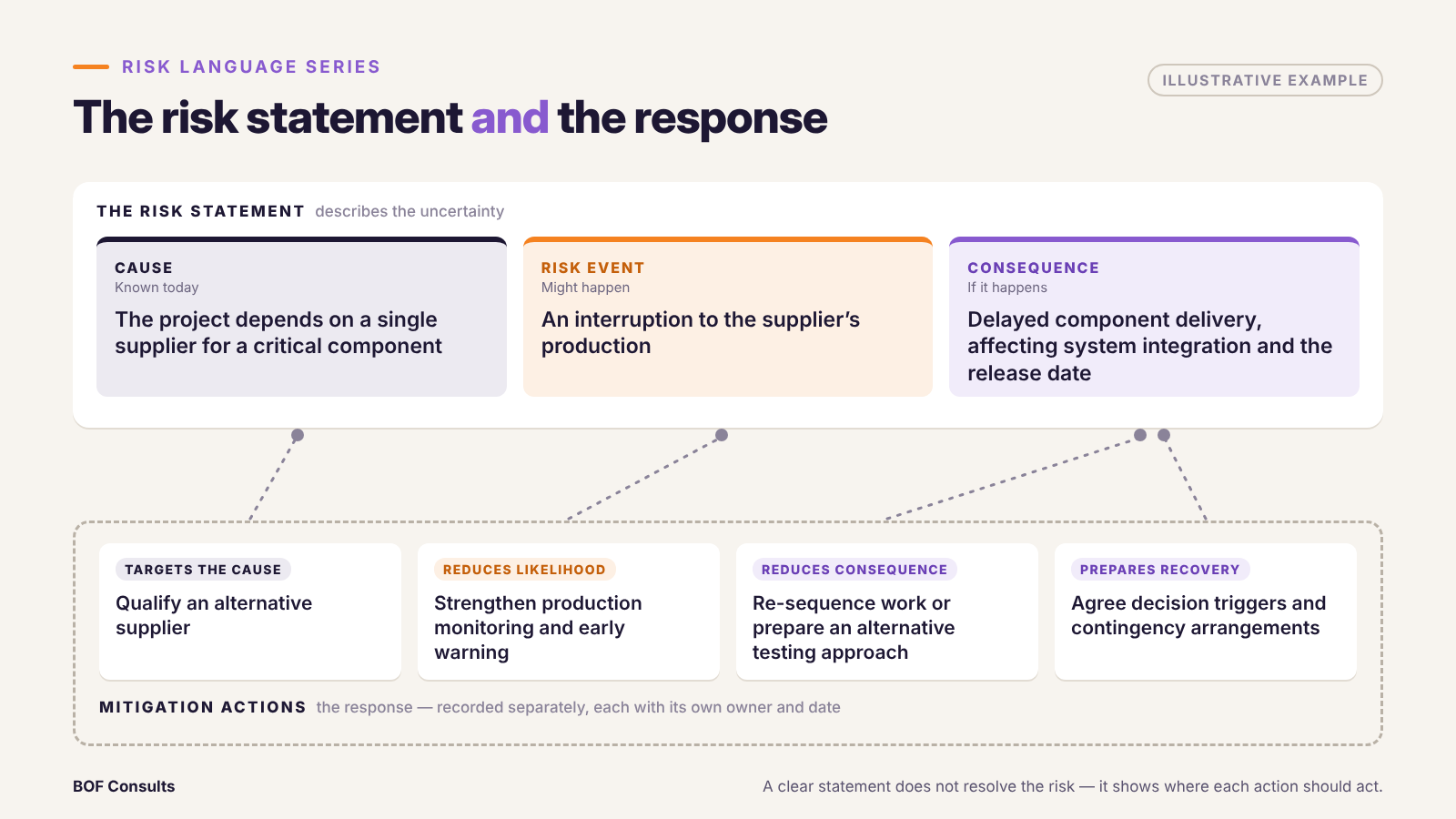
The benefit of metalanguage is that it helps teams understand what they are trying to influence before committing resources to a response.
3. Improve the quality of risk assessment
Poorly articulated risk statements can make assessments inconsistent.
If one team assesses the likelihood of a supplier disruption while another assesses the impact of a possible project delay, their ratings are not meaningfully comparable.
A structured description clarifies the uncertain event being assessed and the consequences against which its significance should be evaluated.
It does not remove judgement or guarantee accurate scores. Assessments still require agreed criteria, credible evidence, appropriate assumptions and consideration of uncertainty.
The aim is to make assessments more defensible and more useful for prioritisation — not to create an illusion of mathematical precision.
4. Use consistent language to reveal connected risks
The benefits extend beyond individual statements.
Suppose different projects record “delay in parts delivery”, “supply chain disruption” and “critical component shortage”.
A common taxonomy maps these entries to a shared supply chain classification while preserving their specific causes, owners and mitigation actions.
Portfolio leaders can then investigate whether projects depend on the same supplier, whether one disruption would affect several milestones and whether a coordinated response is needed.
This is where structured risk language begins to support broader portfolio risk intelligence.
The same principle can be applied to cybersecurity, financial exposure and operational transformation, provided the classifications preserve the context and distinctions that matter to each domain.
5. Prepare risk information for better analytics
Consistent risk descriptions and classifications can provide a stronger foundation for reporting, automated classification and AI-assisted analysis.
Structured metadata can help organisations map related risks, examine dependencies and identify patterns across large datasets.
But structure alone is not enough. AI systems can misclassify risks, overlook context or infer relationships that do not exist. Human review, data quality and clear accountability remain essential.
The practical priority is to establish meaningful definitions and reliable information before investing in more sophisticated automation.
A practical test for your next risk review
Take five entries from your risk register and ask:
- Does each entry identify an uncertain event, rather than only a cause or consequence?
- Is the relevant cause or context clear?
- Does the statement explain the potential effect on an objective?
- Can the team identify a treatment that addresses the source of uncertainty, the likelihood, the consequences or a combination of these?
- Can the risk be classified consistently without losing the detail needed to manage it?
If the answers are unclear, the entry needs work.
A short title is not inherently a poor risk statement. The real test is whether the underlying description communicates enough information to support assessment, ownership and action.
Precision in language. Precision in action.
Risk metalanguage is not a substitute for sound judgement, competent risk owners or effective governance. It is a practical discipline that helps those elements work together.
Applied consistently, it can improve risk identification, support more coherent treatment decisions and make it easier to connect individual project risks to wider programme and portfolio exposures.
The objective is not a perfect register. It is a better decision.
Read next: Why Better Risk Management Starts with a Common Language · From Risk Registers to Portfolio Intelligence
At BOF Consults, we help organisations strengthen project and programme delivery, PMO and project controls, risk management and assurance. If you would like a second opinion on the quality of your risk register, get in touch to book a free 30-minute Initial Consultation.
Over to you: When you review a risk register, how often do you find a genuine uncertain event — rather than a cause, a consequence, an issue that has already happened, or a page of narrative?
About the author. Oladapo Famuyiwa leads BOF Consults. He is a P3M consultant with more than 22 years’ experience across defence, aerospace and space, nuclear, infrastructure and government programmes, and holds the PMI Risk Management Professional (PMI-RMP) and Management of Risk (MoR) certifications alongside PMP, MSP, PRINCE2 and Managing Benefits Practitioner.
Reference
Work with a Partner Focused on Value, Not Just Delivery
If you are responsible for significant investment, complex change, or professional development, BOF Consults is ready to support you.